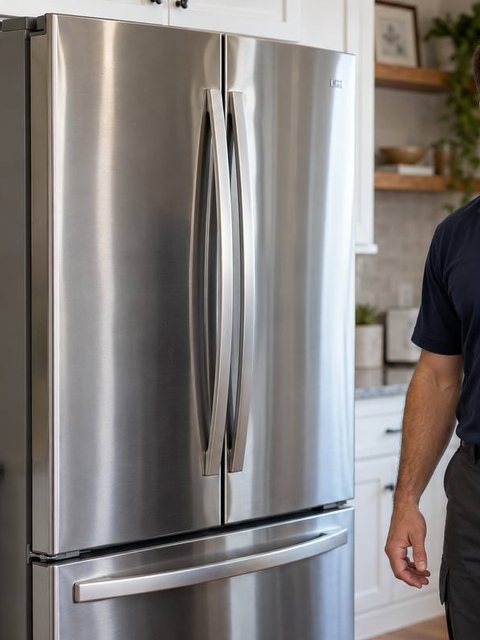
ALSO ON THE VAN
Everything else we repair
Household machines in Olympia, Lacey and Tumwater, plus commercial ice and refrigeration.
A prep table reading 46°F at the start of the rush puts product, not just a part, on the line.
Household machines in Olympia, Lacey and Tumwater, plus commercial ice and refrigeration.
A commercial cooler in a restaurant, cafe or bar breathes the worst air in the building. Its condenser pulls in flour dust, fryer grease and lint, often from a spot a few feet from the grill. Doors swing open all shift, so gaskets split at the corners and hinges sag until the door no longer seals on its own. A prep table’s pan rail sits under hot lights and busy hands, and its evaporator fan works harder than any other in the kitchen. When the coil clogs or a fan motor stalls, the box creeps above 41°F slowly, and the first warning is often a cook’s probe thermometer rather than an alarm. We start with airflow, because most warm coolers begin there.
Location shapes the failures we see. Downtown Olympia kitchens along 4th and 5th Avenues and Columbia Street often squeeze bar-back and undercounter coolers into tight, warm spaces where the condenser has little room to breathe. Glass-door merchandisers in hotel lobby markets along Martin Way in Lacey fight lobby heat and constant door traffic. Prep coolers at the prepared-food stalls of the downtown farmers market work in damp air off Budd Inlet, and the area’s high humidity and fall fog add frost load every time a door opens. Then come the windstorms: when power drops and returns, a cooler has to pull down from warm, and we check the temperature controller and fan motors for surge damage.
| What you notice | What it points to | Code you may see | Our move |
|---|---|---|---|
| The box drifts above 41°F by afternoon and the compressor rarely stops | Dirty condenser coil, or a condenser fan motor that has stopped turning | True · condenser alarm, 1+3 LED flashes | Clean the coil, test the fan motor, then measure amperage and temperature split |
| A frost wall on a freezer evaporator and weak airflow in the cabinet | Failed defrost heater, a bad defrost sensor or a controller that never starts defrost | Turbo Air · F3 | Meter the heater and defrost sensor, then watch one full defrost cycle |
| The coil stays warm even though the compressor has run a long time | Low refrigerant from a leak, or a compressor that is no longer pumping | Turbo Air · C1 | Leak-check joints and tubing, read pressures and write a price for the fix |
| The display disagrees with a thermometer set inside the box | Failed or displaced cabinet temperature probe, or a faulty controller | Turbo Air · r0 or r1 | Compare against a calibrated thermometer, ohm the probe and reseat it in the airflow |
| Fan noise, a ticking blade, or cold air only near the coil | Evaporator fan motor failing, or its blade striking ice | — | Clear the ice, test the motor and find out why ice formed there |
| Sweat or frost along the door edge, and the door will not close itself | Torn gasket, sagging hinge or a worn door closer | — | Replace the gasket or hinge parts and confirm the door seals all the way round |
The pan rail on a pizza prep table read 47°F while the cabinet below held steady. A stack of sheet pans had been parked against the air return, and the rail’s evaporator fan was turning slowly. Our technician cleared the return, metered the fan motor and found it failing. With a new motor from the van and the pans moved, the rail pulled down to 38°F before the first ticket printed.
After a fall windstorm cut power along Martin Way, a bar’s back-bar cooler came back with a dark display and warming bottles. The breaker was fine. Our technician traced the fault to the temperature controller, which had not survived the surge, and confirmed on a direct test that the compressor and fans still ran. We named the part, wrote one price, and the manager approved it before evening service.
A cafe’s Turbo Air reach-in freezer showed F3, the evaporator had disappeared under a white block, and the ice cream had gone soft. Our technician metered the defrost heater and found it open, then found the drain line frozen as well, which is why melt water had refrozen around the coil. We replaced the heater, cleared the drain and watched a complete defrost before leaving.
The deciding question is whether the cabinet can hold 41°F or below, reliably, through a full service. Most failures that stop it are repairable: condenser and evaporator fans, coils, gaskets, hinges, defrost parts, controllers and probes. Replacement enters the conversation when the compressor fails on an older unit, when a leak sits where it cannot be repaired cleanly, or when the cabinet itself is rusted, cracked or waterlogged so it sweats and the gaskets no longer seat. Downtime counts too. If product has to live in another cooler for days while a part ships, weigh that against a unit you could have in place sooner. We write down what we found and what each path involves, and your team makes the call.
You describe the unit and the symptom, and we book a window around service.
Our technician reads the controller, then checks temperatures, amps and pressures to prove the cause.
The manager reviews one written price naming the failed part before we start.
We repair, clean the condenser while the panel is off and verify pull-down temperature.
Warranty terms arrive on paper; installing an ordered part later adds no extra trip fee.
Often, yes. A cooler that will not hold temperature moves up our list when the schedule allows, and our dispatch team works around your service: before opening, in the gap between lunch and dinner, or after close. Many coil, fan, gasket and controller repairs are finished from parts on the van. Anything we must ship in is fitted on a follow-up call, billed with no added trip fee.
Under Washington’s retail food code, refrigerated TCS food is held at 41°F or below, and that is the number inspectors look for on their own thermometers. We do not give legal advice, and a repair is not a promise about any inspection. What we can do is make sure the unit holds temperature, the display agrees with a calibrated thermometer and every door seals.
It depends on the air around it. A coil near a fryer or a flour station clogs far faster than one under a quiet bar. Look at it on a regular schedule, and when you see a gray mat of dust and grease across the fins, it is due. We clean it during any visit and can show your staff how to reach it safely with the power off.
We repair True, Traulsen, Turbo Air, Beverage-Air, Delfield and Atosa reach-ins, prep tables, undercounter and bar-back coolers, and glass-door merchandisers across Olympia, Lacey and Tumwater. If the unit is still covered by the maker’s warranty, we tell you that first so the claim goes where it should. Otherwise we diagnose it, name the failed part and give you one written price.
It pays for the trip and the diagnosis: reading the controller, measuring temperatures and amperage, checking for leaks and naming the part that failed. Once your manager signs the written price, the $99 is counted within the repair total, not tacked on. Should the answer be no, you settle the $99 and we are done.
Yes. A leak usually shows as a slow warm-up with long compressor run times, frost on only part of the evaporator, or an oily spot on tubing. We find it with a detector and bubble solution, repair the joint or component, then evacuate and recharge to the data plate. Many newer units use R-290, and we follow the maker’s procedures for it. If a leak sits inside foamed insulation, we say so in writing.
Phone or form. A photo of the display saves a step; our dispatch team replies with a window.
The code narrows the circuit. A meter, a thermometer or a pressure reading confirms the part.
The repair priced in full, with the $99 inside it. Nothing starts until you sign off.
A full cycle, the area cleaned up, the warranty terms written on your invoice.
The $99 visit finds the fault and folds into the repair once you sign off. Turn the repair down and $99 closes the ticket.