ALSO ON THE VAN
Everything else we repair
Household machines in Olympia, Lacey and Tumwater, plus commercial ice and refrigeration.
Milk at 45°F and a freezer still frozen hard usually means air has stopped moving, not that the compressor quit.
Household machines in Olympia, Lacey and Tumwater, plus commercial ice and refrigeration.
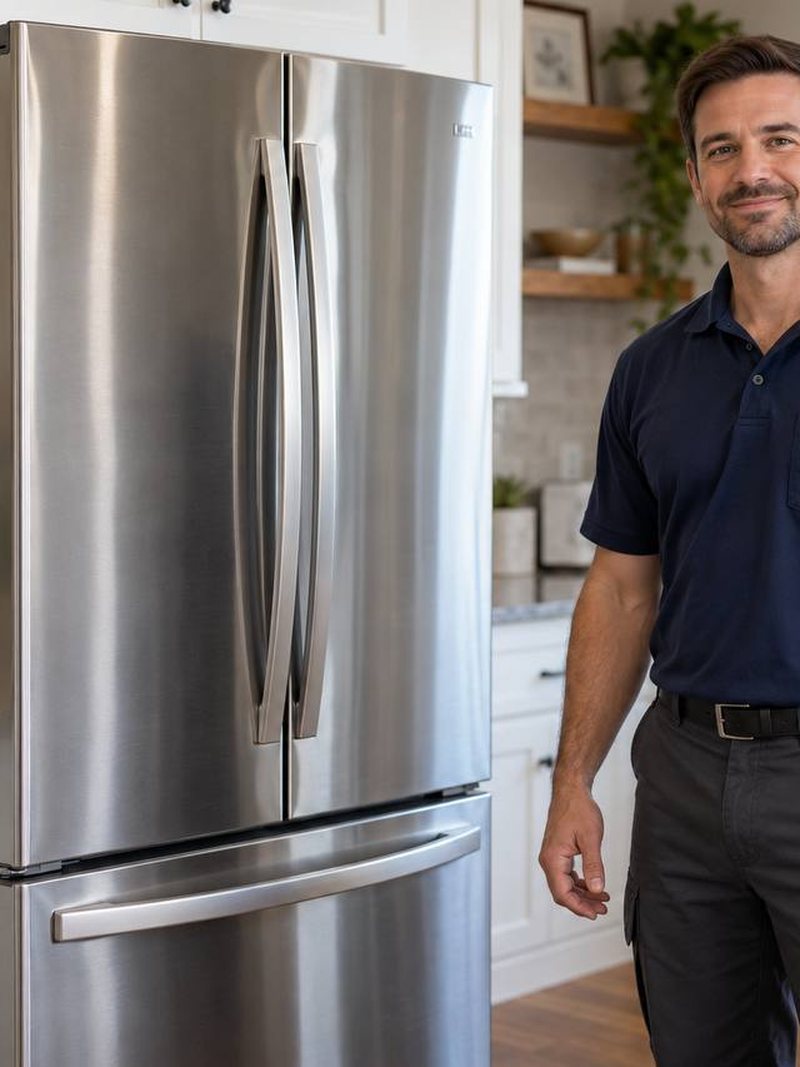
Fall windstorms knock out power across Thurston County, and refrigerators take the hit when it comes back. The surge on restart can finish off a tired start relay or a control board, and a freezer that sat warm through the night may wake up with a soaked evaporator and a drain line that refreezes shut. Then there is the garage. On the freezing nights that most winters bring, a cold garage can fool a combination fridge-freezer into resting while the freezer side softens, and in July the same unit fights heat and lint packed into its condenser coil. Most of these calls are not mysteries. They are fans, defrost heaters, thermistors, gaskets and relays, and our technicians carry the common ones on the van.
The house shapes the call as well. In South Capitol and the Northeast bungalows, refrigerators often sit in alcoves built for a much smaller box, so the condenser breathes poorly and runs hot. Westside ramblers and the Southeast Olympia subdivisions from the fifties through the seventies tend to have remodeled kitchens, with French-door units and water lines threaded through old cabinetry. In Hawks Prairie and on Tumwater Hill, newer homes tuck side-by-sides and bottom-freezers under tight upper cabinets, and many of those machines have reached the age where a fan motor or a defrost sensor gives out. On Bush Prairie and along Littlerock Road, a second freezer in the shop or garage is common, and so is an extension cord we will ask you to retire.
| What you notice | What it points to | Code you may see | Our move |
|---|---|---|---|
| Fresh-food side drifts up while the freezer stays hard | Evaporator fan stalled, or the coil choked with frost | Frigidaire · SY EF | Check fan voltage and blade, inspect the coil, test the defrost parts |
| Snowy frost across the freezer back panel | Defrost heater, defrost sensor or control not finishing the defrost | LG · Er dH | Meter the heater and sensor, then confirm the defrost timing |
| Both sections warm, cabinet sides hot to the touch | Condenser fan stopped or condenser coil packed with lint | LG · Er CF | Clean the coil, test the fan motor, check how the compressor starts |
| Temperatures swing though the settings never change | Freezer or fresh-food thermistor reading wrong | LG · Er FS | Compare sensor resistance to the chart at a measured temperature |
| PF or a high-temperature alarm on the display after an outage | Power loss or surge; cooling may not have fully recovered | Frigidaire · PF | Log temperatures, confirm the compressor and fans restart, check the board |
| Puddle beneath the crispers or across the floor | Defrost drain frozen or clogged, or a seeping supply line | — | Thaw and flush the drain, then inspect the pan and water fittings |
Power returned after an overnight outage, and a Bush Prairie garage chest freezer started humming again, yet it stalled at 20°F. The household was ready to shop for a new one. Our technician metered the compressor windings, found them sound, and traced the stall to a start relay that had failed on the surge when power returned. The relay came off the van, and the thermometer was falling steadily before we packed up.
A Lacey family had a French-door refrigerator sitting at 48°F while the freezer below stayed frozen solid. The display showed nothing unusual. We pulled the freezer back panel and found the evaporator buried in frost, with the fan blade locked in ice. On the meter, the defrost heater showed no continuity. A new heater went in, the coil was melted clear, the fan was confirmed to spin without dragging, and our written warranty stayed on the counter.
In a South Capitol kitchen, a newer refrigerator ran without pause and still sat at 44°F. It had been pushed into an alcove built for a much older box, with no gap at the top or back. The condenser coil was gray with lint and the fan motor was straining. We cleaned the coil, replaced the tired fan motor, and showed the homeowner how much breathing room the installation manual asks for.
Start with the cabinet, not the part. If the liner is intact, the doors seal and the sealed system holds its charge, a refrigerator with a failed fan, heater, thermistor or relay is a repair, and usually a quick one. The harder calls are compressor failures and refrigerant leaks, especially on units whose condenser tubing is buried in the foam walls and cannot be reached without tearing the cabinet apart. There we tell you plainly what the job involves, how long a part takes to arrive and what else on the unit looks worn. We will not talk you into a repair that buys a single season. Where the maker’s coverage is still in force, we raise it first, because it may be the smarter route.
Book by phone or online; a warming refrigerator jumps the queue whenever the day allows.
A text gives your arrival window, and our technician brings thermometers, meters and common parts.
Any display code gets noted as a clue, and a meter reading supplies the proof.
You learn the worn-out part’s name and its one written price before repairs begin.
After the repair we recheck temperatures, clean up and leave a written warranty behind.
Most often the air path. In many refrigerators the cold air starts at the freezer evaporator, and a fan pushes it through a duct or damper to the fresh-food side. If frost chokes that coil or the fan stops, the freezer stays cold while the other side warms. We check the fan, the defrost heater and sensor, and the damper, and we measure temperatures rather than trusting the display.
We try to. A refrigerator or freezer that is losing temperature moves ahead of routine calls whenever the day allows, anywhere in Olympia, Lacey or Tumwater. Meanwhile, leave the doors closed, get whatever spoils fastest onto ice in a cooler, and jot down a thermometer reading if there is one in the house. That number helps our technician before the door even opens.
The $99 pays for the trip, the measurements and a clear account of the fault. Accept our written figure, and the $99 turns out to be one of its lines rather than an extra. Decide the fridge is not worth fixing, and our bill is the $99 alone. Whichever way you lean, the figure sits on paper while every part is still untouched.
It can be. A combination refrigerator-freezer usually senses temperature in the fresh-food section, so in a cold garage it rests and the freezer side softens. A standalone freezer copes with cold better, but it still dislikes summer heat, dust and lint on the condenser. We check the model’s rated room-temperature range and tell you whether the unit, the spot or both need to change.
Whirlpool and its Maytag and KitchenAid cousins, GE with Profile and Café, LG, Frigidaire and Electrolux, Bosch, plus older Kenmore and Amana boxes. Door style matters little to us: side-by-side, French-door, bottom- or top-freezer, and on the freezer side, uprights and chests. When the maker’s coverage has not yet run out on your unit, we point that out first so you can use it before paying us anything.
Open the doors as rarely as possible; a packed freezer holds its cold longer than a half-empty one. Once the fresh-food side passes 40°F, shift dairy, raw meat and leftovers into an iced cooler. Do not unplug and replug the unit over and over, and never chip at frost with a knife, because a punctured evaporator turns a small repair into a sealed-system job.
Phone or form. A photo of the display saves a step; our dispatch team replies with a window.
The code narrows the circuit. A meter, a thermometer or a pressure reading confirms the part.
The repair priced in full, with the $99 inside it. Nothing starts until you sign off.
A full cycle, the area cleaned up, the warranty terms written on your invoice.
The $99 visit finds the fault and folds into the repair once you sign off. Turn the repair down and $99 closes the ticket.