ALSO ON THE VAN
Everything else we repair
Household machines in Olympia, Lacey and Tumwater, plus commercial ice and refrigeration.
Clothes still damp after a cycle, a drum that tumbles cold or a flow-sense warning usually trace to airflow or heat.
Household machines in Olympia, Lacey and Tumwater, plus commercial ice and refrigeration.
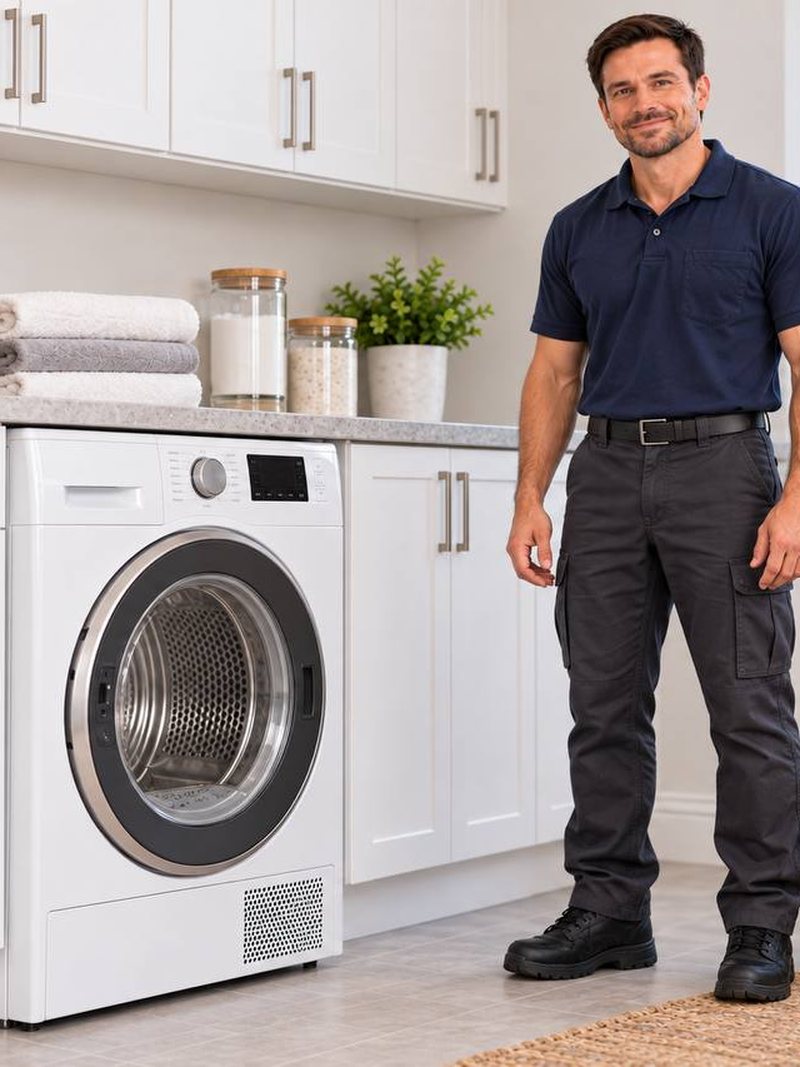
With some 50 inches of rain falling on about 160 days a year, Olympia asks more of a dryer than a sunnier town would ask of the identical model. Loads leave the washer heavier, laundry rooms sit near 80 percent humidity, and the vent carries warm, wet air through cold spaces. Where that duct crosses a crawlspace, water beads inside it, lint clings to the damp metal, and the passage tightens a little each month. Outside, fir needles and moss clog the vent cap. The dryer responds by running long, then by cycling on its high limit or blowing a thermal fuse. A new fuse on a choked vent just starts the countdown again, so our technicians look at both every time.
Fuel matters too. PSE pipes natural gas to many homes in Olympia, Lacey and Tumwater, and out near Black Lake and Littlerock dryers burn tank propane. Either way, ignition relies on a short chain: igniter, flame sensor and two valve coils that tire with heat. Electric dryers depend on a heating element and a 240-volt circuit with two hot legs, and one dead leg makes a dryer that tumbles but never warms. The houses add detail. In newer two-story homes in Hawks Prairie and Tumwater Valley, the laundry sometimes sits upstairs or mid-house with a long vent run to an outside wall, while South Capitol houses often route the duct through a basement or crawlspace. We look at the whole run, not just the back of the machine.
| What you notice | What it points to | Code you may see | Our move |
|---|---|---|---|
| Clothes damp after a normal cycle, flow-sense warning | Restricted vent: lint, a crushed duct or a clogged cap | LG · d90 | Measure airflow at the cap, then clean or reroute the duct |
| Gas dryer tumbles but never heats | Weak igniter, failed gas valve coils, flame sensor, or no gas | LG · gAS | Check the supply, meter the igniter and coils, watch the ignition sequence |
| Electric dryer tumbles cold | Open heating element, thermal fuse or a dead leg on the circuit | LG · nP | Measure voltage at the terminal block, then meter the element and fuses |
| Stops mid-cycle with a sensor code | Exhaust thermistor or its wiring | Whirlpool · F3 E1 | Meter the thermistor against its chart and check the harness |
| Runs very hot, then shuts down | Blocked airflow tripping the high limit, or a stuck cycling thermostat | Samsung · HC | Clear the vent path, test the high limit and the cycling thermostat |
| Drum squeals, thumps or scrapes while turning | Rollers, idler pulley, belt or glides worn down | — | Pull the drum, inspect each wear point, replace what is worn |
Under a Westside Olympia rambler, a foil duct sagged through the crawlspace between the dryer and the rim joist. Our technician found a belly of standing water in it and a plug of wet lint just past that. The dryer had blown its thermal fuse twice. We replaced the fuse, swapped the duct for a rigid run sloped toward the outside, and measured airflow at the cap before and after.
After a fall windstorm, a Lacey household’s electric dryer came back tumbling cold. The element tested fine on the meter, and so did the thermal fuse. At the terminal block, one of the two hot legs read zero. The fault was in the house wiring, not the dryer, so we showed the homeowner the reading, recommended an electrician and left the dryer as it was. The $99 diagnostic was the entire bill.
On Tumwater Hill, a gas dryer lit for a few seconds, went out, clicked back on, and the clothes stayed cool. The igniter was fine. Our technician watched the ignition sequence, saw the flame drop the moment the igniter shut off, and metered the gas valve coils: two had weakened with heat. New coils from the van, three full-heat cycles and a clean vent check finished the call.
Dryers are simple machines, which works in your favor. A drum, a belt, a motor, a blower, a heat source and a handful of thermostats and fuses account for nearly every failure, and all of them can be replaced. We rarely suggest giving up a dryer over one of those parts. The exceptions are a rusted drum that snags clothes, a cabinet damaged by heat, or a control board that is no longer made. There is one more point worth making: if a dryer keeps blowing thermal fuses, the vent is usually the cause, and a new dryer on the same vent will do the same thing. Before any talk of repair, we check whether the manufacturer’s coverage still applies and tell you.
Book by phone or online and tell us gas, propane or electric, plus the model.
A text sets the arrival window; clear some space behind the dryer if you can.
Any code gets read first; a meter and a vent airflow reading then confirm it.
We name the worn or broken part in everyday words and write the price before starting.
We repair, run a heat cycle, check the vent again and leave a written warranty.
Wet air is part of it, but the vent is usually the rest. Lint, a crushed foil duct, condensation in a crawlspace run or a vent cap clogged with needles all slow the airflow, and the dryer then runs long or cycles on its high limit. We measure airflow at the cap, clean or replace the duct and check the heat source before blaming the machine.
It is LG’s flow-sense warning: airflow is restricted somewhere between the dryer and the outside. The number climbs from d80 to d95 as the restriction grows. The dryer will still run, but it runs long and hot. Clean the lint screen and check the outside cap; if the warning stays, the duct needs attention, and we can trace the run for you.
We can. Plenty of Lacey and Tumwater laundry rooms hold a dryer fed by PSE gas or a propane tank, and our technicians handle both fuels. The usual failures sit in a short list: igniter, flame sensor, thermal fuse and gas valve coils. We test each in turn while watching the burner try to light. If you ever smell gas near the dryer, shut the supply valve, leave the room and call the gas utility before calling us.
The $99, and that is the end of it. That figure pays for the visit, the testing and a clear answer about what failed. Go ahead with the repair instead and the $99 never shows up as its own charge; it is one of the lines inside the total. That total is on paper before anything is taken apart.
Yes. Lint burns, and a restricted vent makes the dryer run hotter and longer. Clean the lint screen every load, keep the area behind the dryer clear, and replace plastic or thin foil duct with rigid or semi-rigid metal. If the dryer has blown a thermal fuse, treat it as a warning about airflow rather than just a bad part, and have the vent run checked.
We work on Whirlpool, Maytag, GE, GE Profile, LG, Samsung, Electrolux, Frigidaire, Kenmore, Amana, Bosch and Speed Queen dryers, gas and electric, including stacked sets and heat-pump models. Where the manufacturer still covers the dryer, you hear that from us first so you can pick the route.
Phone or form. A photo of the display saves a step; our dispatch team replies with a window.
The code narrows the circuit. A meter, a thermometer or a pressure reading confirms the part.
The repair priced in full, with the $99 inside it. Nothing starts until you sign off.
A full cycle, the area cleaned up, the warranty terms written on your invoice.
The $99 visit finds the fault and folds into the repair once you sign off. Turn the repair down and $99 closes the ticket.