ALSO ON THE VAN
Everything else we repair
Household machines in Olympia, Lacey and Tumwater, plus commercial ice and refrigeration.
OE flashing with water still in the drum, a washer that wanders across the floor on spin, a door that will not unlock.
Household machines in Olympia, Lacey and Tumwater, plus commercial ice and refrigeration.
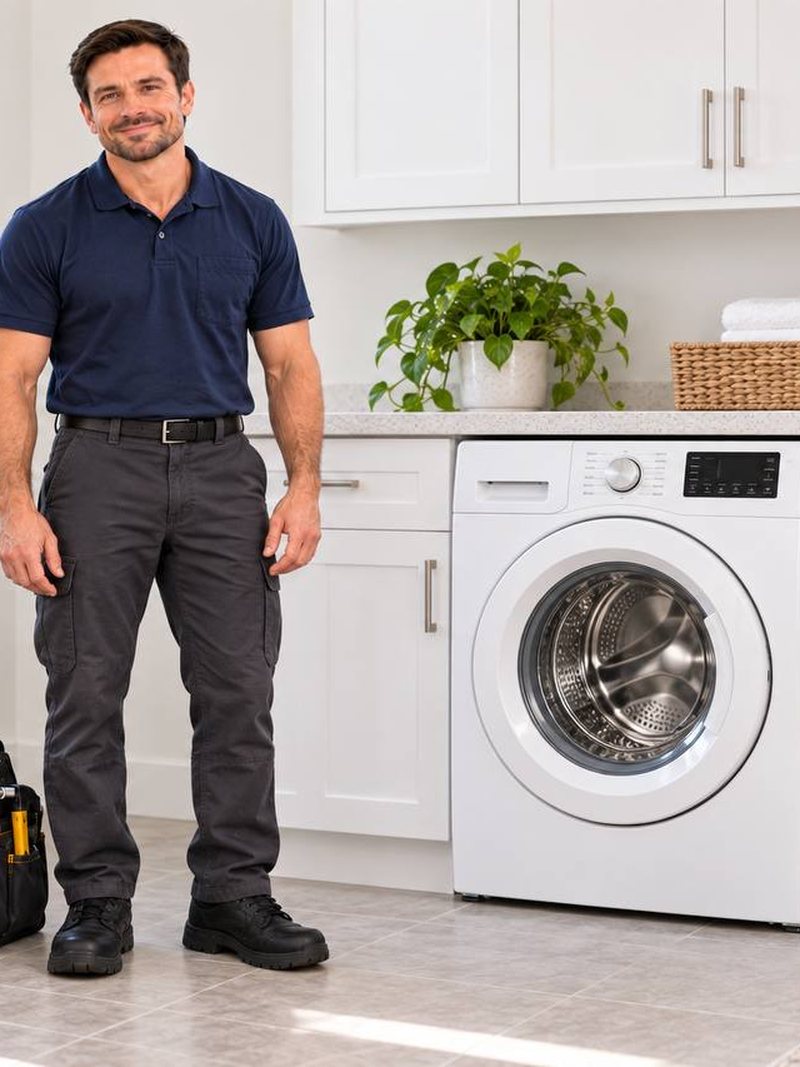
A washer code is the control board reporting what it could not do, not what broke. OE on an LG means the water did not leave the drum in time. That can be a clogged drain pump filter, a sock in the hose, a pump with a cracked impeller or a standpipe that is itself backed up. F8 E1 on a Whirlpool means the board did not see the water it expected; the cause may be a closed tap, a fouled inlet screen or a valve coil that has opened. So our technicians read the code, then prove it: a meter on the pump or valve, a look at the screens, a pressure check at the tap. The part gets named only after that, and not a moment before.
Local conditions add their own list. Laundry rooms here stay damp for much of the year, with rain on roughly 160 days and humidity near 80 percent, so a front-loader shut tight between loads grows mildew in its door boot. In the Westside ramblers and Goldcrest, washers often sit in garages or on slabs where cold concrete keeps everything damp. Soft city water in Olympia and much of Tumwater means a full detergent dose foams hard, and suds codes and dragging rinse cycles follow. In Lacey, a few city wells carry a little iron and manganese that stains fabric and settles in inlet screens. Stacked sets in the Meridian Campus townhomes bring their own challenge: tight closets, short hoses and very little room to work.
| What you notice | What it points to | Code you may see | Our move |
|---|---|---|---|
| Water left in the drum at the end | Clogged pump filter, blocked hose or a failing drain pump | LG · OE | Clear the filter and hose, then meter the pump and watch it run |
| Slow fill, or the cycle stalls early | Closed tap, fouled inlet screen or a failed valve coil | Whirlpool · F8 E1 | Check pressure at each tap, clean the screens, meter the valve |
| Machine shakes, bangs or walks during spin | Unbalanced load, worn suspension or failing bearings | LG · UE | Redistribute and test, then inspect shocks, springs and bearings |
| Door will not lock, or stays locked | Door lock assembly, latch or wiring | LG · dE | Test the lock switch and solenoid, check the harness at the boot |
| Foam piling up and rinse cycles dragging on | Overdosing in soft water, or a non-HE detergent | Samsung · SUd | Rinse out the suds, set a smaller dose, rule out the pressure sensor |
| Musty smell, black spots in the door boot | Mildew from trapped water and a closed door | — | Clean or replace the boot, check the drain path, leave the door ajar |
In a Tumwater Hill laundry room, a front-load washer finished every load with an OE code and an inch of gray water. The owner had cleared the filter and found nothing. Our technician metered the drain pump, found it drawing current but moving little water, and pulled a toddler’s sock from the pump housing beyond the filter. No part was needed, and the next drain emptied the drum in seconds.
A household in the middle of a PCS move-out in Lacey called because the washer would not lock its door, and the rental inspection was days away. Our technician found the door lock assembly failing intermittently on the meter. The part came off the van, a full wash and spin proved the repair, and the written warranty was filed alongside the lease papers for the move-out.
An Eastside Olympia washer kept adding rinses and showing a suds code. The household was filling the detergent cap to the top line, a habit carried over from a hard-water town, and Olympia’s soft water turned it all to foam. Our technician flushed the suds, checked the pressure sensor to rule it out, and marked the right dose on the cap with tape. The machine was fine. The dose was not.
Most washer faults live in parts that bolt on: pumps, valves, door locks, lid switches, belts, shocks and pressure sensors. Those are repairs, and usually same-visit ones. The line moves when the drum bearings fail on a front-load machine, because on many models the bearings are pressed into a sealed outer tub that has to be replaced as a unit. A cracked spider arm, the bracket that carries the drum, lands in the same category. Top-load washers with a worn transmission or a failed tub seal raise the same question. We show you what we found, explain the work involved and let you decide. Should the washer still fall under the maker’s coverage, that comes first, and we say so.
Request a visit by phone or online; a photo of the code on the display helps.
We text an arrival window, and our technician comes ready to drain a full drum safely.
The code is read first, then the pump, valve or lock is proved with a meter.
Before work begins, you learn the faulty part in everyday words and see the job priced in writing.
The repair, a full wash-and-spin test, a dried floor, then the warranty on paper.
Not necessarily. OE means water did not drain in the time the board expected. Check the drain pump filter behind the lower front panel with towels ready, and confirm the drain hose runs without a kink and does not sit too deep in the standpipe. When the code comes back after that, the pump, its wiring or a blockage past the filter is next, and that is where our meter comes in.
Damp air and closed doors. With rain on so many days and humidity high most of the year, water trapped in the door boot and the drain path grows mildew fast. Prop the door open between loads, pull the dispenser drawer out a little, run a monthly tub-clean cycle and wipe the boot folds. If the smell persists, we check the drain pump filter and whether the boot needs replacing.
Our technician comes out, reads the code, tests the parts and names the failure. A single written price follows. If you approve, that figure has the $99 built in, so you never pay it twice. If you pass, the $99 is the full cost of the visit. Tumwater, Lacey and Olympia customers all get the same arrangement.
Yes. Stacked sets and single-unit laundry centers are common in townhomes and apartments, and they take more care to pull out of a closet without scraping floors or straining hoses. We check the space, the hose length and the vent connection before we move the unit, and we reset the leveling legs when it goes back in place.
LG, Samsung, Whirlpool and Maytag fill most of our washer calls, and we also work on GE, Electrolux, Speed Queen and Bosch, front-load, top-load, high-efficiency and agitator models alike. Where the maker’s coverage is still in force, you hear it from us before any pricing, so you can choose your route.
If the washer is leaking or a fill hose looks swollen, yes: close both taps behind the machine. Otherwise leave everything as it is so we can see the fault happen. Please do not keep restarting a cycle that shows a drain or lock code, because repeated tries can overheat a pump or a lock that is already failing.
Phone or form. A photo of the display saves a step; our dispatch team replies with a window.
The code narrows the circuit. A meter, a thermometer or a pressure reading confirms the part.
The repair priced in full, with the $99 inside it. Nothing starts until you sign off.
A full cycle, the area cleaned up, the warranty terms written on your invoice.
The $99 visit finds the fault and folds into the repair once you sign off. Turn the repair down and $99 closes the ticket.