ALSO ON THE VAN
Everything else we repair
Household machines in Olympia, Lacey and Tumwater, plus commercial ice and refrigeration.
An empty bin, hollow cubes or a dispenser grinding away with nothing coming out are the usual complaints.
Household machines in Olympia, Lacey and Tumwater, plus commercial ice and refrigeration.
The ice maker sits at the far end of a long water line. That line starts at a city main or a private well, runs through a shutoff, a filter and an inlet valve, and ends at a fill tube that freezes shut when the flow turns weak. Olympia’s city water is soft and leaves little scale, so failures there tend to be mechanical: a worn module, a valve that fills weakly, a fill tube frozen shut. Lacey’s wells vary between soft and moderately hard; iron and manganese in a few top the aesthetic guideline by a touch. On private wells in the unincorporated county, sediment packs the inlet screen until the cubes shrink to slivers. All of these are routine for our crews, and most take one visit.
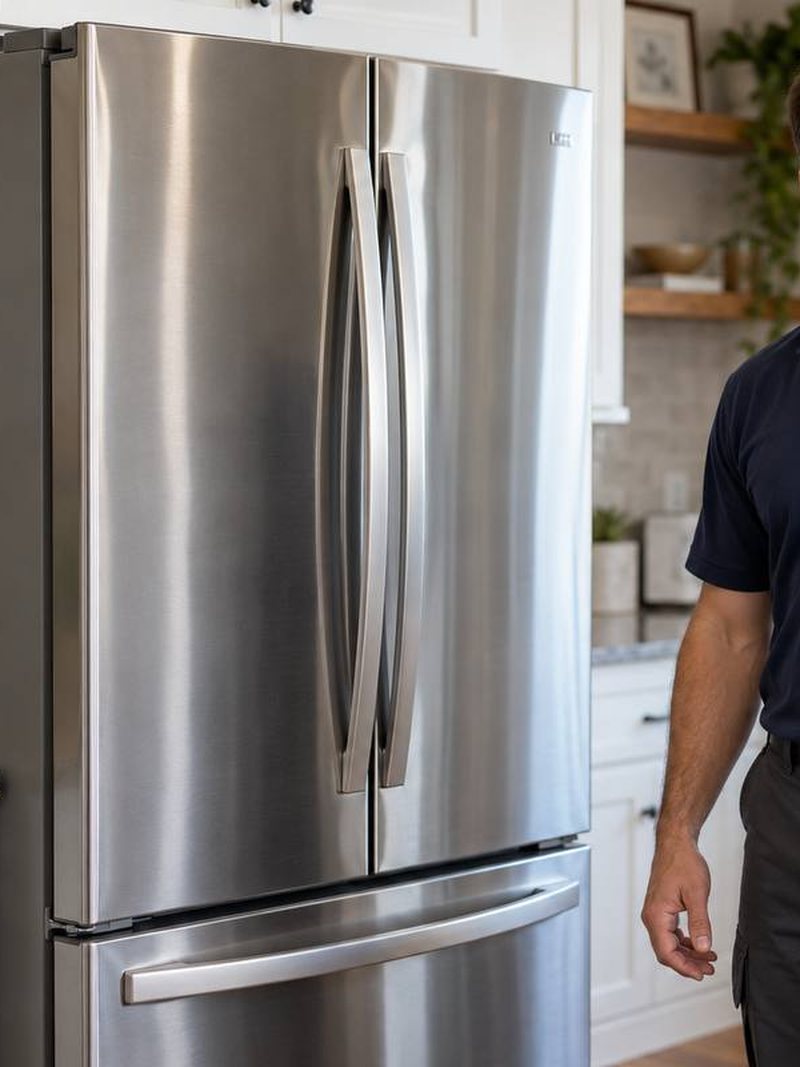
Where the ice maker lives changes the failure. French-door refrigerators with the ice maker up in the door, common in the newer builds of Hawks Prairie and Tumwater Valley, depend on a little fan pushing freezer air through a duct, and frost in that duct is a frequent cause of a slow bin. Freezer-mounted ice makers in older top-freezers and side-by-sides around Eastside Olympia and Tanglewilde fail more simply: a module that stops turning, a shutoff arm stuck in the raised position, a thermostat that never calls for harvest. Out along the Littlerock Road corridor, toward the Black Hills and the forest our company is named for, private wells are common, so we check the filter date and the inlet screen before blaming anything else.
| What you notice | What it points to | Code you may see | Our move |
|---|---|---|---|
| Bin stays empty and the water dispenser runs slow | Low water pressure, a clogged filter or a fouled inlet valve screen | LG · Er gF | Measure flow and pressure, change the filter, check the inlet valve |
| In-door ice maker slows, frost builds in the ice compartment | Ice fan blocked or frost packed in the duct | LG · Er IF | Clear the duct, test the fan, check the ice compartment seal |
| Tray fills but never dumps, or dumps half frozen | Ice maker temperature sensor or harvest control | LG · Er IS | Meter the sensor, then run a forced harvest test |
| Dispenser clicks or grinds, no cubes come out | Cubes fused in the bucket or jammed in the chute | Frigidaire · DI SP | Thaw the bucket, break up the jam, test the auger motor and chute door |
| Small, hollow or crescent-thin cubes | Weak fill from sediment, a failing inlet valve or a low fill setting | — | Measure fill volume, clean or replace the valve, adjust the fill |
| Water on the freezer floor or ice on the fill tube | Fill tube frozen, a seeping valve or an overfill | — | Thaw the tube, check the valve for seepage, verify the fill timing |
A Hawks Prairie household called on a Friday because the in-door ice maker had quit two days before a birthday party. The freezer itself was fine. Our technician found the ice compartment packed with frost from a door seal that no longer sat flat, and the ice fan stalled against it. We cleared the duct, replaced the fan and the seal, and the first harvest dropped before we left.
Out near Littlerock, a side-by-side was making cubes the size of fingernails. The house runs on a private well. We pulled the inlet valve and found its screen coated with orange-brown sediment from iron in the water. A new valve went in with a fresh filter, and we suggested the owners look into a whole-house sediment filter. The next harvest came out full size.
A Tumwater caller had already ordered a new ice maker online. Before swapping anything, our technician checked the obvious. A bag of frozen berries had nudged the shutoff arm into the raised position, so the module was resting exactly as designed. We lowered the arm, cleared a small jam in the tray, ran a test harvest and suggested sending the new part back unopened. The $99 visit settled the call.
Almost always fix it. Ice maker modules, fill valves, ice fans and sensors are small parts, and the work rarely touches the sealed system. The question changes only when the empty bin is a symptom of something bigger: a freezer that cannot hold temperature, a failing compressor, or water damage behind the liner. In that case we tell you what the refrigerator as a whole needs, because a new module will not make ice in a warm box. Some households also choose to shut off the water line and bag their ice, and that is a reasonable answer on an aging unit. When a refrigerator is young enough for the maker’s warranty, you hear that from us first, before any repair decision.
Request a visit by phone or online, with the model number and what the ice maker is doing.
A text gives you the arrival window; clear the freezer door shelves if you can.
We read any code, then check water flow, fill volume and freezer temperature with meters.
You hear which part failed and get a single written price; nothing starts until you approve.
Most ice makers are repaired from van stock, then we run a harvest and leave a written warranty.
Yes. Built-in ice makers are among the most common repairs we do, and most are finished in a single visit with parts our technicians carry. The usual culprits are the inlet valve, the ice maker module, the ice fan, a sensor or a frozen fill tube. A part we don’t carry gets ordered, and we return to fit it at no trip cost.
It often does. Iron, manganese and fine sediment clog the refrigerator’s filter and the screen at the inlet valve, and the ice maker notices before anything else, because it needs a quick, steady fill. We check pressure at the valve, look at the screen and the filter date, and say whether a sediment filter where the water enters the house would protect the new valve.
The first harvest often comes later the same day once the mold is cold, and a full bin usually takes about a day. Throw out the first few batches after a new valve or filter goes in, since they can carry carbon dust or a stale taste. If the bin still looks thin the next morning, call us back and we will take another look.
It includes the trip, the testing and a plain answer about which part failed. Okay the written figure, and the $99 turns into one line within the repair total rather than a separate fee; decline, and that $99 is the visit’s entire cost. Many Lacey ice maker calls end with a valve or fan swapped on the spot, so the choice usually comes quickly.
Plenty of owners try, and on simple freezer-mounted units it can be a few screws and one plug. The catch is that a dead module is often not the fault. A fill tube frozen solid, an inlet valve that barely opens or a warm freezer produces the same empty bin. We would rather prove the cause first than see you buy a part that was never broken.
We fix the built-in ice makers in GE, Whirlpool, KitchenAid, LG, Frigidaire and Bosch refrigerators, plus the other household names, whether the maker is mounted in the freezer compartment or up in the door. For restaurants, cafes and hotels, our commercial crew also services Hoshizaki, Manitowoc, Scotsman and Ice-O-Matic machines.
Phone or form. A photo of the display saves a step; our dispatch team replies with a window.
The code narrows the circuit. A meter, a thermometer or a pressure reading confirms the part.
The repair priced in full, with the $99 inside it. Nothing starts until you sign off.
A full cycle, the area cleaned up, the warranty terms written on your invoice.
The $99 visit finds the fault and folds into the repair once you sign off. Turn the repair down and $99 closes the ticket.