ALSO ON THE VAN
Everything else we repair
Household machines in Olympia, Lacey and Tumwater, plus commercial ice and refrigeration.
An oven that crawls toward temperature, a cooktop burner stuck clicking without a flame, a door still latched after self-clean: each traces to one part.
Household machines in Olympia, Lacey and Tumwater, plus commercial ice and refrigeration.
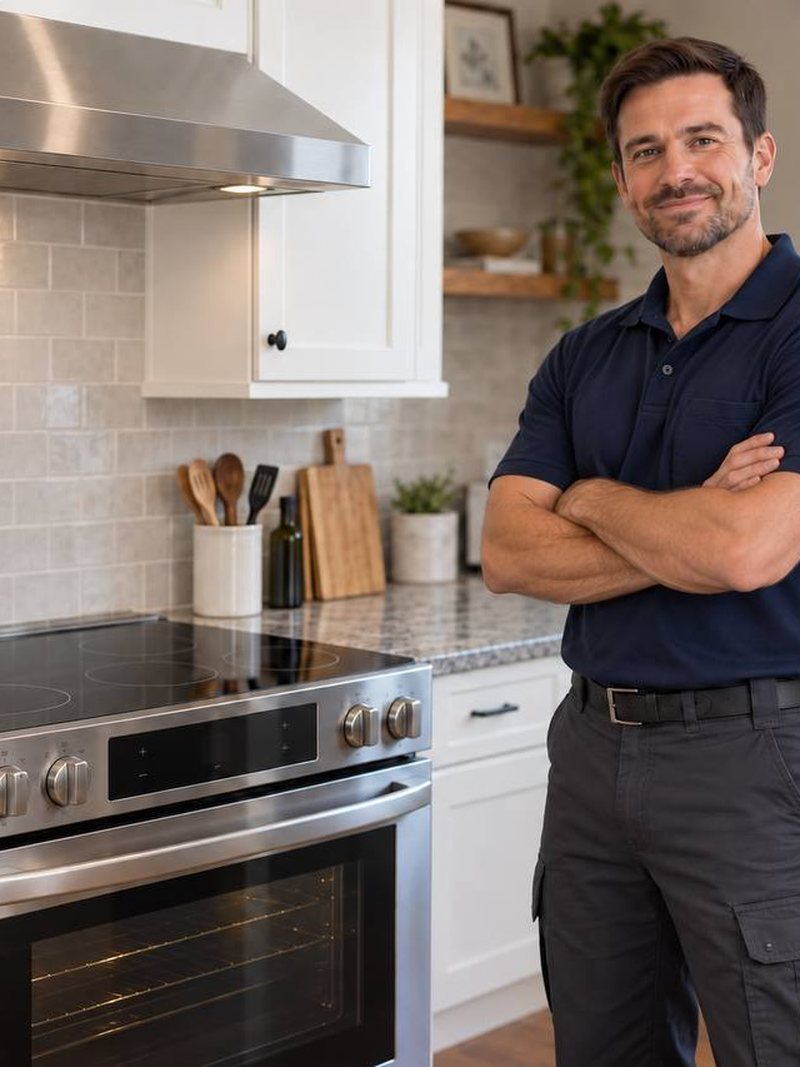
Cooking fuel in this area splits more evenly than most people expect. PSE brings natural gas to large parts of Olympia, Lacey and Tumwater, and roughly a third or more of the homes in the three cities heat with gas, so gas ranges are common. At the rural edges, past Black Lake, along Steamboat Island Road or out toward Littlerock, propane tanks feed the same kinds of burners through different orifices. Everyone else cooks on electric coil, radiant glass or induction. Each fails in its own way. Gas ovens lose igniter strength until the safety valve will not open. Electric ovens burn through bake elements. Induction tops fault on cooling fans and power boards, and wall ovens slowly cook their own control wiring.
Kitchen layouts differ just as widely. In Jubilee and Panorama, many households cook on smooth glass tops and depend on clear, responsive controls, so a stuck key or a sensor fault that scrambles the display matters more than a slow burner. Older Olympia neighborhoods such as Carlyon and Holiday Hills often keep freestanding ranges in original-size openings, where a loose spark wire, a tired bake element or a greasy igniter is the usual complaint. In the Meridian Campus townhomes and Horizon Pointe, slide-in electric ranges are the norm. Across all of it, damp air plays a part: humidity near 80 percent and months of fog let moisture creep into spark switches, which is why a burner that clicks nonstop after a wipe-down is such a common winter call.
| What you notice | What it points to | Code you may see | Our move |
|---|---|---|---|
| Gas oven sits cold for minutes before the bake burner catches | An aging igniter that no longer pulls the safety valve open | — | Read the igniter’s amp draw against the valve rating, then check the valve |
| Broil works, bake does not | Bake element broken open, or a board relay that has stopped switching | — | Meter the element and the relay output before ordering anything |
| Oven overshoots the set temperature badly | Relay stuck closed or a sensor out of range | Frigidaire · F10 | Check sensor resistance and relay behavior with the oven under load |
| Sensor fault on the display, oven shuts down | Oven temperature sensor open or its wiring damaged | GE · F3 | Meter the sensor at its harness and again at the board |
| Door stays locked after a self-clean cycle | Door lock motor, lock switch or heat-damaged wiring | GE · F9 | Meter the lock motor and its switches; look over wiring near the vent |
| Burner igniters click and will not stop | Moisture or grease in a spark switch, or a failing spark module | — | Dry and test the switches, isolate the module, check the wiring |
In a Southeast Olympia kitchen, a gas oven’s igniter glowed orange for minutes while the cavity stayed cold. The owner had smelled no gas, which was the point: the igniter’s amp draw had sagged under what the valve requires to open. Our technician measured it, showed the reading against the valve’s requirement, replaced the igniter from the van and brought the oven to temperature twice before leaving.
A Lacey townhome oven finished its self-clean cycle and then refused to unlock, showing F9. A roast was planned for that evening. We tested the lock motor and found it seized, with a wire behind it browned by repeated cleaning heat. The motor and a short run of high-temperature wire were replaced, the door released, and we suggested hand-wiping the oven more often and self-cleaning less.
Near Littlerock, a new range had been connected to a propane tank without being converted. The flames were tall, yellow and lazy, and the pots came off sooty. Our technician confirmed the regulator and orifices were still set for natural gas, completed the conversion with the kit supplied with the range, tuned each burner to a steady blue flame and leak-checked every connection.
Cooking appliances are built from parts that wear on their own schedule: igniters, elements, sensors, switches, lock motors. Replacing one of them on a range with a sound body is usually the obvious call. We slow down in three cases. A control board that is no longer made, with no reliable rebuilt option, can end the question. A glass cooktop cracked through a burner zone should not be used, and on many models the glass comes only as a full top assembly. And a gas range with a corroded or leaking valve body gets a hard look, because gas safety comes before anything else. We explain each case plainly, and a range still under the maker’s warranty gets that mentioned first.
Book by phone or online and tell us whether the range runs on gas, propane or electric.
An arrival window comes by text; please keep the oven cool and the cooktop clear.
We read any F-code, then prove the fault with a meter, a thermometer or a gas check.
You hear which part failed and get one written price; the $99 visit sits inside it if approved.
After the repair we heat the oven to temperature, check every burner and leave a written warranty.
Usually the igniter. A hot-surface igniter on most gas ovens has to pull a certain amperage before the safety valve opens; with age it keeps glowing while its draw drops, so ignition comes late or never. We read the amps, hold them against the valve’s rating, and swap the igniter when it falls below. Any gas smell comes first: get out of the house, then call the gas utility.
Yes. Homes near Black Lake, along Steamboat Island Road and out toward Littlerock often cook on propane. The burners, igniters and valves are the same kinds of parts found on natural gas models, but the orifices and regulator settings differ. Before we blame any part, we confirm the range is configured for the fuel actually reaching it.
We can. Induction faults usually come down to a cooling fan, a power board, a coil connection or a sensor that misreads the pan. We check the error shown, test the fan and the boards, and confirm with a magnet that the cookware is compatible, since a pan that will not hold a magnet is a frequent cause of a zone that refuses to start.
Only the $99. It buys the call, our measurements and a clear answer on which part died, and no other line appears if you pass. Approve the written quote instead, and its total already contains that $99 rather than adding it on top. You decide with the number already on paper.
Let it cool completely first; many ovens will not release until the cavity drops below a set temperature. Next, cut power at the breaker, wait about a minute, and restore it. If the door still will not open, or the display shows a lock code such as GE F9 or Frigidaire F90, the fault most likely sits in the lock motor or a lock switch, which needs testing. Please do not force the latch.
Our technicians handle Frigidaire, Whirlpool, GE with its Profile and Café lines, Bosch, LG, KitchenAid, Samsung and Maytag, along with Electrolux, Amana and Kenmore. That covers freestanding and slide-in ranges, double wall ovens, radiant glass tops and induction. Anything still under a maker’s warranty, we flag first.
Phone or form. A photo of the display saves a step; our dispatch team replies with a window.
The code narrows the circuit. A meter, a thermometer or a pressure reading confirms the part.
The repair priced in full, with the $99 inside it. Nothing starts until you sign off.
A full cycle, the area cleaned up, the warranty terms written on your invoice.
The $99 visit finds the fault and folds into the repair once you sign off. Turn the repair down and $99 closes the ticket.