TUMWATER · MORE REPAIRS
The burner clicks but will not light, or the oven reaches 250 and stalls there.
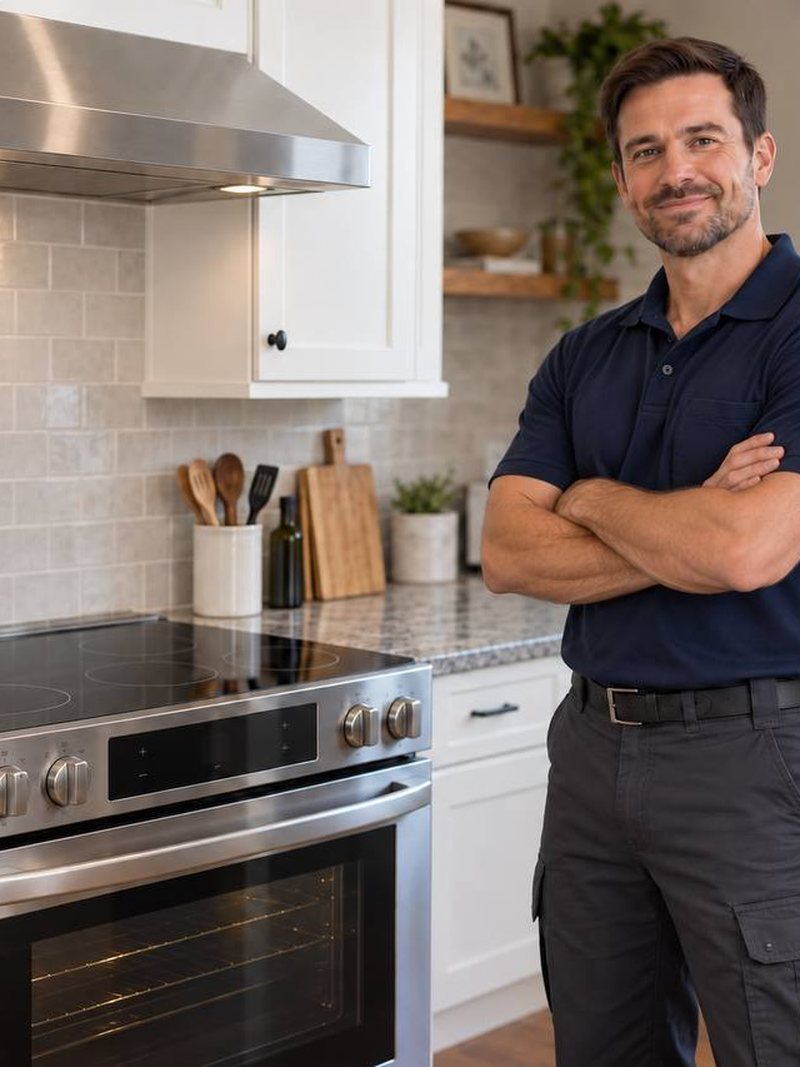
Tumwater cooks on all three fuels. Piped natural gas reaches many neighborhoods, and plenty of households here heat with it too, so gas ranges are common in Bush Prairie and Tumwater Valley kitchens. Past the end of the gas main, on Littlerock Road, Old Highway 99 and the rural south of the county, propane takes over. That matters: a range has to be set up for the fuel it burns, with the right orifices and regulator setting, or flames run tall and yellow on one fuel and weak on the other. Electric ranges and wall ovens fill in the rest, from coil tops in older ramblers to glass and induction in houses built this century. Damp air is the local enemy, corroding igniter terminals and spark switches.
One scene we know well: a house in the falls-side historic district, platted as New Market in 1845, with a modern gas range set into an old kitchen. The oven takes ages to light, sometimes with a soft whoomp, and never quite reaches the set temperature. That pattern points to a weak hot-surface igniter; the oven’s gas valve will not open until enough amperage flows through it. We measure the igniter’s amperage instead of guessing, check the valve and the supply, then set our own thermometer in the cavity to see whether the set temperature arrives and stays. In propane homes we also verify the conversion and watch flame color at every burner. Our crew knows the back roads toward Capitol Forest, and a tank-fed range at the end of a gravel drive is ordinary work for us.
| What the range does | Usual culprit | How we check it |
|---|---|---|
| Igniter glows orange, oven burner stays dark | Worn hot-surface igniter the gas valve won’t respond to | Put an ammeter on the igniter circuit, test the valve, confirm supply pressure |
| Cooktop burner clicks without lighting | Wet or cracked electrode, plugged burner ports or a failing spark module | Dry the burner head, clear its ports, test electrode and module in turn |
| Yellow, sooty flames on propane | Range still set for natural gas, or regulator not converted | Verify orifices and regulator for propane before any other repair |
| Electric oven bakes unevenly or runs cold | A burned bake or broil element, or a drifting sensor | Ohm out both elements and the sensor, then verify with a thermometer |
| Door stays locked after self-clean | Door lock motor, lock switch or control fault | Let it cool, test the lock circuit, then release the door safely |
| Brand · code | Meaning | Our next step |
|---|---|---|
| GE · F9 | A component in the door lock circuit has failed | Test the lock motor and switches before replacing the control board |
| GE · F7 | Key panel fault, often a stuck or shorted touch pad | Check the ribbon connection and key panel before condemning the control |
| Frigidaire · F10 | Thermal runaway: the control saw oven heat past its safe limit | Power-cycle once, then meter the oven sensor and the relay board |
| Whirlpool · F3 E1 | Oven temperature sensor, its wiring or the control has a fault | Measure sensor resistance at the harness and again at the control connector |
It starts with a text that sets the arrival window. At the range, our technician asks what fuel it burns and what changed, reads any code, then tests: igniter current on gas and propane ovens, element and sensor resistance on electric, and oven temperature against our own thermometer rather than the display. You hear which part failed and why. One written price follows, and nothing comes apart until you approve it. Once you do, the price already covers the $99 diagnostic; decline, and we collect the $99 and nothing further. Igniters, elements and sensors for most models ride on the van. Shipped parts get installed on a return stop at no extra trip cost, and every job ends with a test bake and a written warranty.
Yes. Propane ranges along Littlerock Road, Old Highway 99 and the other rural edges are regular work for our team. We confirm the propane conversion was actually done, look at flame color and height at each burner, and test the oven igniter and valve. A range left on natural gas settings burns dirty on propane, and we sort that out before anything else.
A brief whiff as the burner catches can be normal. A lingering smell, or one that builds before ignition, is not. Turn the oven off, close the range shutoff if you can reach it, get everyone outside and call your gas supplier’s emergency line. Once the supplier has cleared the line, we can diagnose the igniter, valve or connection that caused it.
No. Sign off on the written price and you’ll find the $99 diagnostic listed among its lines, never counted twice. Leave the range unrepaired and our visit costs $99, not a cent beyond. Whichever you choose, the faulty part and the reasoning behind it are laid out for you before you decide.
We do. Induction tops, radiant glass tops, coil ranges, gas and dual-fuel ranges, and single or double wall ovens are all in our scope, across GE, GE Profile, Café, Whirlpool, KitchenAid, Frigidaire, Electrolux, Bosch, LG and Samsung. Induction faults usually live in the power board or a coil sensor, and we test before naming either.
Often it is. Igniters, elements, sensors, spark modules and door locks are ordinary repairs, and a well-built range can take several of them over its life. When the control board for an older model has gone out of production, or the oven cavity is rusted through, we say so and let you weigh it. You decide with a written price in hand.
The fault gets named and priced on paper; approve the work and the visit is already inside that figure.